RL With MimicKit
KangEngine can be used as a backend engine of
MimicKit through KangEngine’s Python
package. Use the backend_kangengine branch of MimicKit and keep MimicKit in a
separate Python environment.
Note: GPU contact sensors provide contact count, contact state, and accumulated normal impulse and force. Tangential friction impulse and a full six-axis contact wrench are not currently exposed as sensor outputs.
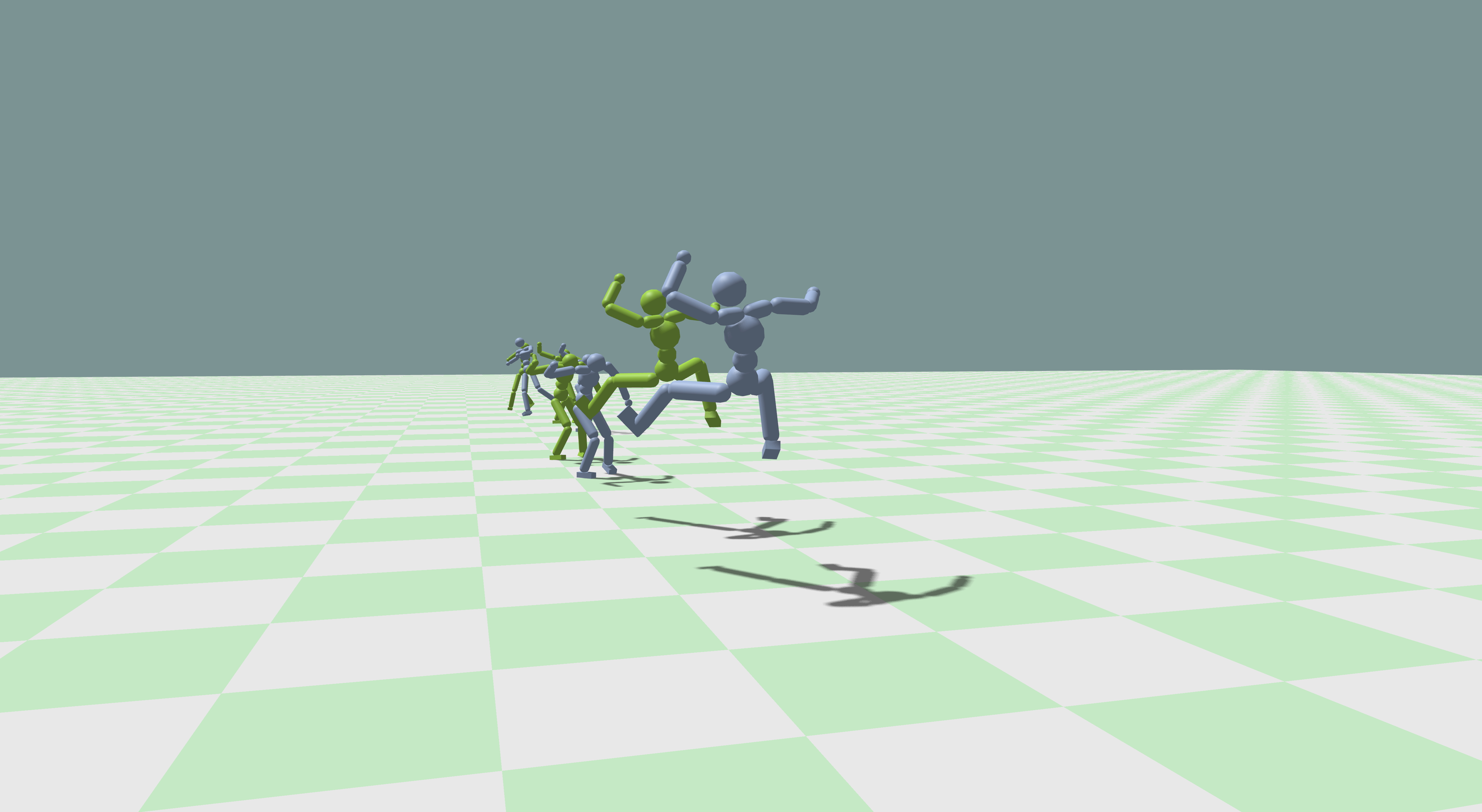
MimicKit setup and run commands
Clone the KangEngine-enabled MimicKit fork branch.
git clone -b backend_kangengine https://github.com/Gudegi/MimicKit.git
Create and activate a MimicKit Python environment with uv.
cd MimicKit
uv venv .venv --python 3.12
source .venv/bin/activate
Build KangEngine’s Python extension from the KangEngine repo.
cd /path/to/KangEngine
make build_python
Install KangEngine’s Python package into the MimicKit environment.
uv pip install -e ./python
Install MimicKit dependencies.
cd /path/to/MimicKit
uv pip install -r requirements.txt
Run a small motion visualization test.
python mimickit/run.py \
  --mode test \
  --num_envs 1 \
  --engine_config data/engines/kangengine_engine.yaml \
  --env_config data/envs/view_motion_humanoid_env.yaml \
  --visualize true \
  --devices cpu \
  --test_episodes 10
Run pretrained policy inference with KangEngine.
python mimickit/run.py \
  --mode test \
  --num_envs 4 \
  --engine_config data/engines/kangengine_engine.yaml \
  --env_config data/envs/amp_humanoid_env.yaml \
  --agent_config data/agents/amp_humanoid_agent.yaml \
  --visualize true \
  --model_file data/models/amp_humanoid_spinkick_model.pt
Train an AMP policy with KangEngine.
python mimickit/run.py \
  --mode train \
  --num_envs 4096 \
  --engine_config data/engines/kangengine_engine.yaml \
  --env_config data/envs/amp_humanoid_env.yaml \
  --agent_config data/agents/amp_humanoid_agent.yaml \
  --visualize false \
  --out_dir output/
For reference, the MimicKit KangEngine backend uses an engine config like this:
engine_name: "kangengine"

control_mode: "pos"
control_freq: 30
sim_freq: 120
env_spacing: 5
enable_self_collisions: false
The backend_kangengine branch already includes
data/engines/kangengine_engine.yaml, so you usually do not need to create it
manually.